



Home equity is the difference between the value of your home and the debt remaining on your mortgage. Simply put, home equity is the portion of your home that you truly own.
For most Canadians, a home is their largest financial asset. Learning how to tap into that value can unlock powerful financial opportunities. Here is everything you need to know about home equity and how to make it work for you.
Key Takeaways
- Home equity grows as you pay down principal or when market values go up, but drops if local real estate prices fall or if you take on additional debt against the home.
- Three ways to tap into your home equity are: home equity loans, second mortgages, and mortgage refinancing.
- Alternative lenders like Alpine Credits primarily focus on your home’s equity, making home equity loans accessible even with non-traditional income or credit challenges.
What is home equity, and how does it work?
When you buy a house with a mortgage, your lender places a legal charge against the property to secure the loan. Equity is what’s left over once all secured claims are accounted for.
For example, if your home is appraised at $500,000 and you owe $300,000 on your primary mortgage, your equity is $200,000.
It’s important to remember that equity isn’t cash sitting in a bank account. To unlock that value, you either have to sell the house or borrow against it with a secured financial product, like a home equity loan.
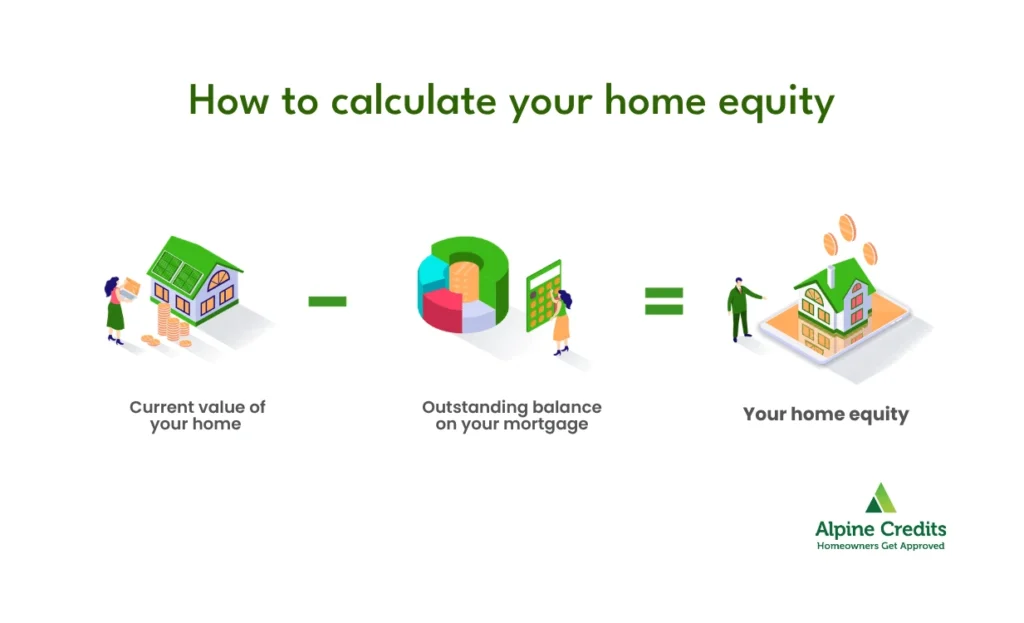
How to calculate your home equity
Your down payment is where your home equity begins. For instance, if you buy a home for $600,000 and put down 20% ($120,000), your starting mortgage balance is $480,000. Your home equity calculation looks like this:
$600,000 (current home value) – $480,000 (remaining mortgage) = $120,000 (home equity)
Every regular mortgage payment you make chips away at your principal and builds your equity further.
However, equity isn’t built solely through your monthly payments; it also moves with the real estate market. Your equity can increase as your property gains value. On the flip side, if local property values decline, your home equity may shrink along with them.
Total home equity vs. accessible home equity
A common point of confusion for Canadian homeowners is assuming that if they have $300,000 in home equity, they can borrow $300,000. Financial institutions in Canada typically do not allow you to extract all of your equity, which is why most lenders limit the maximum Loan-to-Value (LTV) ratio
How to calculate accessible home equity on a property with multiple liens
| Debt Obligation | Balance / Value | Total Equity Remaining |
| Appraised Home Value | $850,000 | $850,000 |
| Less: First Mortgage Payout | $390,000 | $460,000 |
| Less: HELOC Balance (Drawn) | $45,000 | $415,000 |
| Less: Second Mortgage | $60,000 | $355,000 |
| Total Debt / Ending Equity | $495,000 Debt | $355,000 Total Equity |
In the example above, the maximum borrowing capacity is calculated against the total property value rather than the remaining equity alone. Subtracting the existing debt obligations from the lender’s maximum LTV will reveal how much equity is available.
Note: Never ignore liens held by secondary lenders or tax authorities. All registered claims against the title reduce your equity and borrowing capacity.
How home equity changes over time
Home equity moves constantly throughout your ownership. It fluctuates based on two main factors: how much debt you owe and how much your home is worth.
| What Increases Equity | What Decreases Equity |
| Regular mortgage principal payments | Dropping real estate market values |
| Extra lump-sum mortgage prepayments | Drawing down on a HELOC |
| Natural real estate market appreciation | Taking out a second mortgage |
| High-ROI home renovations that raise appraisal value | Refinancing to cash out equity |
3 ways to borrow against your equity in Canada
If you need access to cash, you don’t need to sell your home. You can tap into your accumulated equity through the following products:
Home equity loans
A home equity loan gives you a single lump sum of cash. You then repay the loan at a fixed or variable interest rate over a set period, called a term.
Homeowners often use home equity loans for expenses that can increase their property’s overall value, such as a kitchen remodel or an additional bedroom. Others may use home equity loans for other purposes, such as consolidating credit card debt or expanding a business.
Second mortgages
A second mortgage is a loan that lets homeowners borrow money against the value of their home without changing their current mortgage. This loan is listed after your first mortgage on your home’s title, meaning the first mortgage is paid off first if you sell the house.
A second mortgage does not replace your first mortgage. You have to make payments on both loans at the same time.
Mortgage refinance
Refinancing breaks your existing mortgage agreement and replaces it with a larger loan, allowing you to pocket the difference in cash.
Unlike a standard mortgage renewal, which simply extends your loan at the end of a term with no stress test or added fees, a mortgage refinance lets you break your contract at any time to access cash or restructure your debt. However, because a refinance creates an entirely new mortgage, it requires a full reapplication, legal fees, and potential prepayment penalties.
Common Uses for Home Equity
Because equity borrowing is secured by real estate, interest rates can be significantly lower than unsecured personal loans or credit cards.
Common uses for home equity financing include:
- Home Renovations: Upgrading kitchens, bathrooms, or structural elements can improve quality of life and boost property value.
- High-Interest Debt Consolidation: Rolling 19%+ credit card balances into a lower-rate equity loan simplifies monthly budgeting and reduces total interest costs.
- Major One-Time Life Expenses: Paying for post-secondary tuition, unexpected medical costs, or large family purchases.
Pros and Cons of Home Equity Borrowing
| Benefits | Considerations |
| Secured loans carry lower risk for lenders than credit cards or personal loans. | Higher interest rates than your primary mortgage. |
| Access substantially more capital than traditional unsecured loans. | Additional appraisal and legal fees. |
| Funds can be used for any financial need. | Your home secures your borrowing. |
How to Qualify for a Home Equity Loan
Qualifying for a home equity loan in Canada follows a process similar to securing a primary mortgage. You will need to provide proof of income, list your existing debts and assets, and pay for a professional home appraisal to confirm the market value.
Traditional Canadian banks and credit unions evaluate applicants through a strict underwriting process, focusing heavily on:
- Gross Debt Service (GDS) & Total Debt Service (TDS) Ratios: Ensuring your housing costs and total debt payments stay within federal guidelines (typically capped around 39% for GDS and 44% for TDS).
- Mortgage Stress Test: Proving you can afford payments at the qualifying interest rate (the higher of the Bank of Canada benchmark rate or your contract rate plus 2%).
- Credit Score & History: Requiring a strong credit score (typically 660 or higher) to unlock better rates and terms.
But not all home equity lenders are the same. Alternative lenders look beyond strict GDS/TDS debt ratios and mortgage stress tests, allowing homeowners with non-traditional income or credit challenges to access their home equity.
How Alpine Credits can help
Since 1969, Alpine Credits has helped thousands of Canadians turn their home equity into a real financial opportunity. If you have built equity in your property, we believe accessing those funds should be straightforward and hassle-free.
Our process is designed for speed and accessibility, so you can apply in three simple steps:
- Apply online—the Alpine Credits application is simple and takes only minutes to complete.
- Get approved— if you own your home and have at least 25% in equity, you are eligible for a home equity loan from Alpine Credits. Get approved in minutes.
- Receive funding— Alpine Credits will directly deposit the money in your bank account within a few days of your approval.
Contact one of our Financial Solutions Specialists for a free, no-obligation quote today.
Frequently Asked Questions (FAQs)
How much home equity do I have, and how much can I borrow?
How much equity you have depends on the home’s current market value minus all outstanding debts. Lenders calculate your maximum borrowing limit using a Loan-to-Value (LTV) cap, and subtracting your current debt obligations from that amount will show your accessible equity.
What is the difference between a mortgage and home equity?
A mortgage is the debt you owe to a lender to finance the purchase of your property. Home equity is the percentage of the property’s value that you own free and clear of that debt.
Can I get a home equity loan with bad credit?
Yes. While traditional banks rely heavily on credit scores and strict income stress tests, specialized equity lenders (such as Alpine Credits) focus on the amount of equity built up in your home rather than your credit score.